
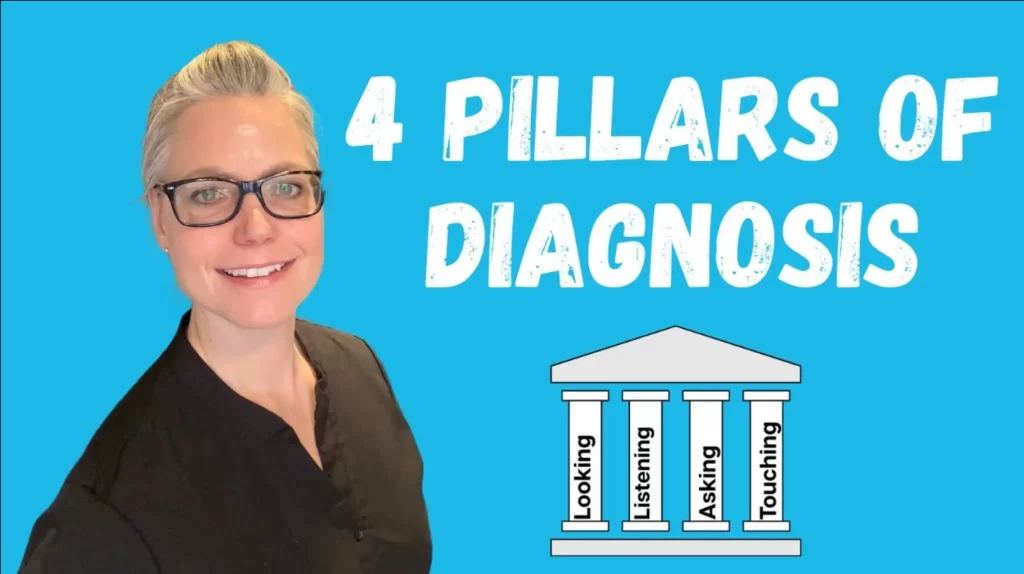
In this video, I explain how traditional Chinese medicine practitioners use the four pillars of diagnosis—looking, listening (and smelling), asking, and touching—to gain a comprehensive picture of your health, not just treat isolated symptoms. I walk through how we observe your physical appearance, especially your skin and eyes, and why tongue and pulse diagnosis are such powerful tools for understanding internal organ imbalances. You’ll learn that every symptom is just one part of a bigger pattern, and that we ask detailed questions about your lifestyle, emotions, and even body odors to find the true source of any disharmony. I demonstrate how pulse readings go far beyond checking your heart rate, as we assess the quality, speed, and depth to uncover subtler issues. Altogether, my goal is to help you see why TCM diagnosis is so holistic and to encourage you to become more aware of your own body’s signals, starting with a look at your tongue and a feel of your pulse.
Topics Covered in this Video
- The four pillars of TCM diagnosis: looking, listening/smelling, asking, and touching
- The importance and method of tongue diagnosis in traditional Chinese medicine
- How pulse diagnosis reveals internal health and organ imbalances
- The holistic approach of TCM versus Western medicine’s focus on symptoms
- How practitioners use observations and questions to personalize treatment plans
Connect with Vans
Unedited Video Transcript
Ever wondered why your acupuncturist looks at your tongue and checks your pulse, even when you’re coming in for back pain? In traditional Chinese medicine, diagnosis goes way beyond symptoms. We use the four pillars of looking, listening, asking and touching to determine what is going on. What’s the underlying root of your condition? In this video, you’ll learn how practitioners read your tongue, feel your pulse and ask those targeted questions to build a complete picture of your health, mind, body and spirit. Curious about how TCM sees your system? You’ll never look at health the same way again. Let’s explore the ancient art of diagnosis. Hi, I’m Vanessa from Blue Frog Wellness and welcome to my channel where I share insights from traditional Chinese medicine to help you better understand your health and well being. Before we begin, I want to be clear that this channel is for information and educational purposes only. Although TCM has been practiced for thousands of years, it is not a substitute for medical professional advice.
Should you happen to have a medical concern or anything going on that you need to consult somebody with, do not hesitate to reach out to a licensed healthcare practitioner. In today’s video, we’re going to learn how TCM practitioners diagnose in terms of the four pillars of diagnosis. Looking, listening, asking and touching. Unlike Western medicine, which relies on imaging and lab results, traditional Chinese medicine looks to assess the human body from a more holistic approach which takes into account your imbalances in your energies, any internal disharmonies, and looks to find the root cause of your symptoms. By the end of this video, you’ll understand how acupuncturists create the best treatment plan for each individual, which is based on their findings within the four pillars of diagnosis. And why exactly that pulse and tongue diagnosis are so important. In tcm, every symptom is a part of a bigger pattern in the body. Instead of just treating one issue at a time, we look at the whole the body, mind and energy flow.
To do this, traditional Chinese medicine practitioners rely on what we call the four pillars of diagnosis. Looking, listening and smelling. Asking and touching. Number one, looking or observation. Examining the face, posture, skin and tongue. Number two is listening and smelling. So observing the voice, the breath and even the subtle body odors that you might have. The third is asking and this is really our interrogation part of the acupuncture session where we really want to understand your symptoms, your emotions, your lifestyle and your health history.
And number four is touching or palpation, so feeling the pulse, skin temperature and muscle tension in the body. Let’s break these down and see why each of them is important in determining a TCM pattern of diagnosis. The first pillar is looking, which means we’re going to be using our eyes to look at the patient in front of us and observe what exactly their physical appearance looks like, maybe what their demeanor is, and definitely what their energy is like. So what we’re actually looking for is your face. You know, what does your face tell me, what does the condition of your skin, the color of your skin, the tone of your skin, and the vibrancy of your skin, all of those will indicate different things in Chinese medicine, and especially, we’re going to look at your eyes. We want to see what kind of vitality is coming through the eyes. Are your eyes dull and lusterless, meaning you’re probably fatigued and you don’t have a lot of vitality to you at this moment in time, or are they really shiny and bright and exuding a lot of shen coming through, which is your spirit coming through your eyes? All of these things will tell us something. Now, when we look specifically at your skin, we’re going to see, you know, if it’s pale, perhaps you’re blood deficient.
If it’s a bluish tone, maybe you’re lacking circulation, or if it’s bright white, maybe you’re very chi deficient. So we’re going to look at the color, and not only just of the whole face. We’re going to look in different areas. So a yellowing around the eyes might indicate that you’ve got spleen or liver issues. Maybe some redness around the nose is going to tell us something different about your heart. We’re always going to be looking to see where different colors and different textures of your skin are presenting themselves on different areas of the face, which will indicate to us many different things. And lastly, we’re going to be looking at your tongue. The tongue tells us a whole lot, and it’s going to be one of the most important diagnostic tools that we have in traditional Chinese medicine.
So the tongue is really reflecting the state of your internal organs. So we look for the color, the shape, the coating, and the moisture level to identify different patterns of imbalance. So we’re going to be looking to see, is your tongue quivering? Is your tongue really pointed and stiff? Is your tongue really too big for your mouth? So you’ve got teeth marks on the sides or what we call scallops. We’re going to be looking to see if it’s puffy in some areas and not as puffy in others. All of those Things are going to tell us something different about each specific internal organ. Now, the color of your tongue is going to tell us something. So, of course, if it’s very pale and definitely very flat, you’ve likely got a lot of blood deficiency happening. If it’s a red tongue, you’ve got too much heat going on.
If it’s really swollen with those teeth marks, again, probably your spleen has the Qi deficiency because it’s too big for your mouth. And lastly, if you’ve got any kind of coating, a yellow or white coating is going to tell us that you have some internal dampness. So the tongue really does give us a window into the body’s internal state without needing blood tests or any imaging. So if we look a little bit more specifically at the tongue, you’re going to see that the organs are represented in different areas of the tongue. The very back of the tongue is the kidneys and the urinary bladder. Right in front of that area, we’re going to find the large and small intestine area. Right down center is the spleen and the stomach, or your digestive center. And then right at the tip is going to be reflective of your heart area.
And behind the heart is your lung area. Now, on the sides, we’re going to be seeing the areas representing the liver and the gallbladder. So, as you can see, if there’s different colorings, different swellings or divots, maybe you’ve got red papillae that are popping up in different areas of the tongue. That will all indicate that there’s something going on with these specific internal organs. Now, as we mentioned, the color will tell us something. So a pale tongue is going to tell us that there’s probably blood deficiency, definitely Qi deficiency, going on. If your tongue is a normal strawberry red color, that’s a very healthy picture. That’s what we want to see.
If your tongue is a bright red, though, or you’ve got a red tip or red sides, that indicates that there’s too much heat in either the heart or the liver. And we want to make sure that we can know that comparative to the rest of the tongue, so we can address those specific organs. Now, if your tongue is purple, you’ve got some stagnation going on. That can be Qi stagnation. And over long term, the more purple your tongue is, the more blood stagnation you have. And you can even have a black tongue, which is the nth degree of that. Right. Really toxins in the blood, lots of stagnation, lots of stopping and starting.
And really not a good picture of health if you’ve got a black tongue. So have a look in the mirror and see what your tongue shows you. You might be very surprised to see the color, the shape, the texture or any of the coatings. Next, we’re going to use listening and smelling to assess some of the more subtle signs of imbalance with someone. So by listening, what we’re looking for here is the quality and sound of your voice, but also your breathing, because both of those will tell us something. So a weak, soft voice may indicate QI deficiency, whereas a loud and forceful voice might indicate something that’s more excess. So maybe you’ve got some liver excess liver imbalance causing you to have a more powerful and robust voice. And then any type of shortness of breath or sighing is going to tell us something about the liver and the spleen in terms of QI deficiency or weakness.
Now, for smelling, we’re also going to pick up on any other odors your body is giving off. So a strong body odor is going to indicate some heat in the system and toxic buildup. And if you’ve got a sweet smell or even a rotten smell, it can indicate that you’ve got severe digestive issues, obviously. So we’re going to use that to guide more questioning and figure out what’s really going on at the root. So if you’ve ever noticed, your white T shirts seem to come out of the wash and you still have yellow pit stains and they smell pretty, pretty bad. You’ve got pretty bad BO in there. That’s always going to be too much heat, likely in your large intestine, but probably in the lungs as well. So there’s ways that we can remedy that.
So just know that yellow stained shirts don’t necessarily just mean you’re not using the right detergents. It actually means an imbalance in the body. So the third pillar is asking, and this is the portion of the treatment that I call the interrogation. Because your acupuncturist is really going to ask you a whole host of questions which will help guide us to find out exactly what pattern of disharmony your showing. So that that will guide our treatment and our recommendations for you so that we can balance out your picture. So we’re not just going to ask about your main complaint. We’re also going to be asking questions about how you’re sleeping, about your digestion, about your food cravings, we’re going to ask about your emotional well being and what sort of emotions seem to be coming up for you on the regular or maybe something that’s new or out of the ordinary for you. We’re going to be asking about your levels of perspiration.
We want to know if you’re sweating in the daytime or if you have night sweats. We’re going to ask about your temperature overall, if you’re feeling cold or hot most of the time. And all of these things will help to guide us in terms of where is the main imbalance? So where is the root of everything and then where is the branch? So this the actual thing you’re coming in for. So maybe you’re coming in for back pain, but we’re also going to find out constitutionally what might be out of balance there, so that we can not only treat your back pain, but we can also supplement or balance your constitution so the back pain doesn’t continue to return. For example, if you’re blood deficient, that back pain might come up time and time again because you really don’t have the actual nourishment to nourish your kidneys, to nourish your blood, to nourish your spleen, which will only help your muscles and your ligaments and your actual bone structure. So if that’s always deficient, you’re always going to be susceptible to having that back pain reoccur. So in the moment, we can treat your back pain and help you with that right away, but we also want to address that underlying root so that you don’t have the back pain reoccurring time and time again. So the fourth pillar of diagnosis in TCM is that of touching or palpation, which we’re actually going to be looking mostly at pulse diagnosis here.
Now, pulse diagnosis is one of the greatest tools we have in Chinese medicine to really ascertain what’s going on with someone’s body, because it’s actually going to tell us a whole lot more than just the rate or the rhythm of someone’s pulse, like what we’re looking for in Western medicine. In traditional Chinese medicine, we’re actually looking for a whole lot more. We’re looking for the quality, we’re looking for the speed, we’re looking for the width, we’re looking for the depth of your pulse. And all of those things combined are going to paint a really nice picture of what’s internally happening inside someone’s body. But it is quite complex. So let me show you exactly what we’re looking for when we feel your pulse. So let’s start with the pulse positions. An acupuncturist is checking three pulse the front, middle and back.
And all of those pulse positions are going to reflect different internal organs within your body. Now, you have to remember that each of those internal organs is paired to another organ. So essentially, the three positions we’re checking on the right hand will correspond to six different internal organs, and on the left hand, six more internal organs. So we can effectively check what’s going on in terms of your energy flow, your blood flow, the vitality of 12 different organs. Now, we’re going to complicate that and add three different levels. We’re going to have the superficial level, the medium level, and the deep level. And all of those different levels and pulse positions are going to equate to a really nice picture of what’s going on internally in your own body. So we know what we need to address, what we need to work on.
So based on this, there’s up to 29 different pulse patterns. So there’s really a lot to know. And with that being said, there are many different qualities of your pulse. So, for example, we could have a wiry pulse, which kind of feels like a taut guitar string. You know, it’s got some tension in it, and as the pulse is hitting the acupuncturist fingertips, it feels very forceful. Not necessarily a completely smooth pulse, but very agitated feeling. A wiry pulse is going to be seen in someone who has a lot of stress or is experiencing liver Qi stagnation. Then we might have a slippery pulse, which is what it sounds like.
It feels kind of smooth, a little bit like a pearl rolling underneath the ball of your finger. And it has a smooth, gliding sensation to it, but too smooth, too. Too much of that gliding nature, which indicates dampness, phlegm, or it could indicate that you’re pregnant. Then we have a thin pulse, and a thin pulse is always going to reflect that you either have yin or blood deficiency or both. And it’s exactly what it sounds like. The width of the pulse isn’t really that wide. It’s more narrow than it really should be. You could have a flooding pulse, which really comes on strong and then kind of fades away.
Um, that could be a sign of heat. It could be a sign of a couple other things. You could have a choppy pulse, which feels very uneven. Um, it’s described as having a knife scraping bamboo, and it’s usually linked to blood stasis or a really extreme deficiency. So we have a multitude of different pulse qualities that we’re actually feeling for. So all of those qualities paired up with the different locations that we’re finding them in. So which organ are they paired with and at what level? The superficial middle or deep level is going to really give us a nice indicator of what’s happening within your own body in this moment. So, as you can see, every pulse tells a story, and no two pulses are ever going to be exactly the same.
Now you can see why this could take a practitioner their entire career to really master, because there is so much to really listen with at your fingertips. The beautiful thing is we can check what’s going on within your system right here in this moment. And when I was in acupuncture school, some of the workshops I took specifically on pulse diagnosis. We would take Chinese herbs, and, of course, all the different Chinese herbs will have different effects on the body. So some would speed up your pulse, some would smooth out your pulse, some would just give it a different overall quality. And so you could, you know, take a couple of drops of a tincture, Chinese herbal formula, and within 30 seconds, your pulse quality would change. So we can really get a grasp on what’s happening with you in the moment where it’s. It’s right here.
And now we are. We’re not waiting on diagnostic tests that, you know, might have been reflecting your body a week ago or two weeks ago. We’re actually finding out how things are going for you right here in this moment, to become really skilled at pulse reading. It’s one of the best tools, the most elegant tools you will have in your tool belt, to be able to decipher what’s going on in someone’s body, often before symptoms actually appear. So the next time an acupuncturist feels your pulse, know that they’re not just looking for your heart rate. We’re actually tuning into the subtle energy of your whole being. Now, while pulse diagnosis is the greatest palpation tool that we use, Chinese medicine practitioners will also, as we are needling specific points, feel up and down the actual meridians on your body to understand a little bit more about where there might be deficiencies or blockages. And you can literally feel that in the actual, actual tone of the skin around these acupuncture points.
So if there’s a deficiency in a specific acupuncture point, it feels like a divot. If there’s excess, it almost feels like a little bubble under the skin. And so many of us can really feel what’s happening in the qi flow of each of your meridians. And that really helps to guide the acupuncturist to know specifically where to put the needles and which ones you might need based on that palpation skill that we have honed over the years of our practice. Now you know how acupuncturists use those four pillars of diagnosis to figure out exactly what’s going on with you specifically. And by doing this, hopefully you have a better understanding of why it’s so important that we look at your tongue and feel your pulse. And that way we can create that pattern of disharmony which will guide our treatment, but also help you to better understand what you can do to also balance out your pattern. So if you happen to pause this video and go check out your tongue in the mirror to see exactly what might be going on, let us know what you found in the comments below.
Perhaps you were surprised to see that you had a thicker coating than you thought, or maybe you had some teeth marks or some puffiness that you didn’t think were present. Well, now you know what that means. And now you know exactly how your acupuncturist is is creating a pattern of disharmony by using those four pillars of diagnosis and why it’s so important that we feel your pulse and we look at your tongue in each treatment session. As always, if you enjoyed this video, do like the video and subscribe to the channel so that you can be aware of all the TCM tips that will be coming in future videos. Thanks so much for watching. I’ll see you in the next one.